- 83%
- less time spent screening candidates
- 6 weeks
- from concept to launch, with a team of three
- 3 pilots
- Visa, Boston Consulting Group and PepsiCo
- My role
- Founder and CEO. I own the product, the interview method and the architecture.
- Team
- Three at launch. A small engineering team since, whose work I direct.
- Timeline
- Launched in 6 weeks. Led since, April 2025 to today, over 800 commits.
- Pilots
- Visa, Boston Consulting Group and PepsiCo (2026)
- Stack
- Next.js, React, TypeScript, OpenAI Realtime over WebRTC, GPT-5.6 for scoring, Supabase, Vercel, OpenTelemetry and Grafana
I learned to interview before I built an interviewer
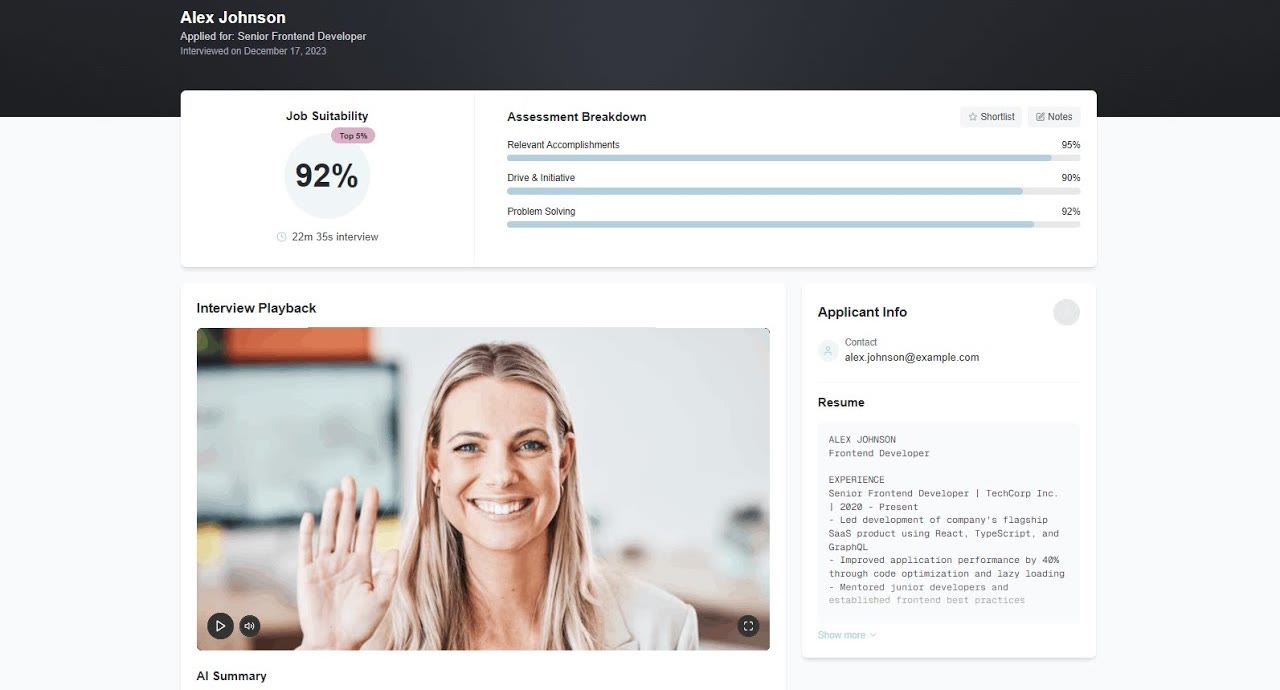
High-volume hiring breaks at the first round. Recruiters can't give hundreds of applicants a real conversation, so most get filtered on keywords and are never heard. Valitron gives every applicant a voice interview of up to 40 minutes with Vali, our AI interviewer, then scores it and ranks the shortlist.
Before I planned a single part of the architecture, I read Lou Adler's Hire with Your Head cover to cover. I had to become an expert interviewer myself before I could build a product that interviews better than most humans. Adler's performance-based hiring became the backbone: interview against what the job actually has to deliver, probe for evidence, and score ten factors instead of gut feel.
We launched in six weeks with a team of three. Three problems have carried most of the engineering weight since.
Turn-taking
A voice interview lives or dies on who speaks when. Talk over a candidate and you lose their answer; wait too long and it feels like a bad phone line. I split the problem in two. The browser decides when the candidate may speak. OpenAI's semantic_vad model decides when they have finished.
How we got to 400 ms
- Jun 2025I tuned voice detection, turned off mic auto-gain and delayed Vali's first greeting.
- Jan 2026Vali kept interrupting itself: its own voice leaked back through the candidate's mic. Echo cancellation and longer silences fixed it, at the cost of speed.
- Jan 2026A latency pass: required silence cut from 1,800 to 800 ms, the noise model's buffer halved.~2.5 s faster
- Jan 2026I moved end-of-turn detection from silence timers to a semantic model that judges whether a thought is finished.
- Feb 2026Muting now follows measured audio levels, not data-channel events, which arrived out of step with what the candidate heard.
- Mar 2026Handoff guards cut from 1,000 and 700 ms to 200 ms each.1,700 → 400 ms
No barge-in
An interview isn't a chat. The transcript is what gets scored, so I chose one voice at a time, which keeps it clean and in order.
Trade-off It feels slightly less natural when a candidate wants to cut in.
Semantic end-of-turn over timers
Candidates pause to think. A silence timer punishes exactly the thoughtful answers we want to hear in full.
Trade-off Latency is less predictable, and it depends on the provider's model.
Evals that steer the Examiner
The Examiner is a separate reasoning model that reads the whole transcript and scores Adler's ten factors. Its first version sounded confident and was quietly wrong. So I stopped editing the prompt, built an eval suite, and made every prompt change since answer to it.
| Real interview | Production v1 | My cold read | v2.4 |
|---|---|---|---|
| Interview A | 78 | 78 | 78 |
| Interview B, 30 minutes | n/a | 73 | 70 |
| Interview C | 64 | 73 | 72 |
| Interview D, graduate | 63 | 67 | 68 |
| Interview E | 53 | 68 | 65 |
| Interview F | 27 | Incomplete | Incomplete |
Assert order and policy, not exact scores
LLM judges drift a few points from run to run, so a test that expects exactly 72% fails on noise. The 22 golden cases check score bands, rankings, a five-run spread of 8 points or less, and banned wording, such as blaming candidates for topics nobody asked about.
Test the request that ships
The harness calls the same request builder as production. A prompt regression can't pass the eval and still reach a candidate.
28 characters flipped a verdict
Rewording two phrases about the same behaviour moved a candidate from Limited to Good Match in 3 of 3 runs. So v2.4 needs two weak factors, not one, before it rules someone out.
Trade-off I deliberately depart from Adler here, and I've documented why.
Don't punish the pipeline
The model flagged "inconsistencies" that were really speech-to-text spelling the company name three different ways. Proper-noun variants are now treated as transcription noise, not dishonesty.
Know when to stop prompting
Two rounds of instructions couldn't restore the model's eye for boilerplate answers. A stronger model did, unprompted.
What it still gets wrong: delivery sways the score more than substance. A coached rewrite of the same interview scored 89 against the original's 70. I track that as an open problem rather than hide it.
An in-flight black box
When an interview ends early, the candidate is gone and the recruiter wants to know why. Was it their Wi-Fi, a laptop going to sleep, a closed tab, or us? I scoped a flight recorder for every interview and directed a team member to build it. I later hardened it myself.
One interview, 18:20 until it stopped
Sample data- 00:061phase: liveVali and the candidate are connected
- 12:102event-page-hiddenThe tab went to the background
- 13:523event-page-visibleBack after hiddenForSec: 102
- 18:204event-webrtc-connection-droppedinterviewStopped: true
- 18:21abandonment beaconphase: live, elapsedSec: 1101
What the drop event says, most likely first
- Network connectivity was lost mid-interview
- ICE keepalive packets timed out
- A firewall or NAT dropped the UDP flow
- OpenAI's server closed the peer connection
- The tab was backgrounded and the OS throttled it
Heartbeats never missed a beat and the tab was visible when the call dropped, so it wasn't the laptop sleeping. That points to the network. The Examiner marks it as a technical failure, not a candidate who quit.
Every event carries its hypotheses
Each of about 33 browser events ships with a ranked list of likely causes, a suggested fix and the code location. Whoever reads the logs starts from a diagnosis, not a stack trace.
Last seen alive
A heartbeat every 60 seconds, how long the page was hidden, and the interview's phase when it stopped. Together they separate a dropped network from a closed laptop lid.
A dropped call isn't the candidate's fault
Connection drops flow into the Examiner. A transcript that ends abruptly is marked as a technical failure instead of being scored as a candidate who quit.
Lost logs are the worst logs
Serverless functions froze before their logs were exported, so saved interviews lost their final lines. I flush after each response now, and a sanitiser keeps each session snapshot under a 256 KB cap.
Trade-off An extra flush on every response.
Other calls I made
The model has no clock
Asking Vali to "wrap up if time permits" produced a six-minute interview. The platform now sends the wrap-up at 37 minutes, and a test fails if that phrase ever returns to the prompt.
A hard stop at 40 minutes
Set from context-window maths, about 590 tokens a minute. It's a quality limit first and a connection guard second.
Unknown is not zero
A factor we couldn't assess now returns nothing instead of a zero. Before that, a candidate whose mic failed outscored a fluent but empty one, 60% to 40%.
Recruiter questions are data, not instructions
Custom questions are wrapped as data to block prompt injection, and loaded on the server so a candidate can never grade themselves.
Numbers
- 83%
- Less time spent screening candidates2025
- 6 weeks
- From concept to launch, with a team of three2025
- ~400 ms
- To hand the turn back to the candidate, down from ~1,700 msMar 2026
- 1.2 pts
- Mean score error against my own hand scoring, down from 9.4Aug 2026
- 3 pilots
- Visa, Boston Consulting Group and PepsiCo2026